

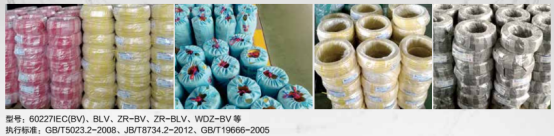
Application: This series of copper‑core and aluminium‑core PVC‑insulated cables and wires is designed and manufactured for power supply circuits, household electrical appliances, precision instruments and telecommunication equipment with an AC rated voltage of 450/750 V and below. As one of the most fundamental and widely‑adopted wiring products in the low‑voltage electrical industry, these insulated conductors serve as the basic power‑transmission link connecting power sources to terminal‑use equipment in countless residential, commercial and industrial environments. Copper‑core variants deliver outstanding electrical conductivity, stable current‑carrying performance and low‑energy loss during long‑term operation, making them ideal for high‑reliability circuits where consistent power delivery is prioritised. Aluminium‑core cables, on the other hand, provide a cost‑effective lightweight alternative with satisfactory conductive capability, well‑suited for large‑scale fixed‑wiring projects that require economy without sacrificing basic electrical safety.
The wide application scope covers several distinct usage categories. In power distribution systems, these cables undertake the task of transmitting electric energy to terminal loads within low‑voltage circuits. For daily‑use household appliances, they provide safe internal and wall‑embedded wiring for air‑conditioners, refrigerators, lighting fixtures, kitchen equipment and other domestic electrical devices. When deployed together with measuring instruments, control meters and laboratory equipment, the stable insulation layer effectively reduces external electrical interference, ensuring accurate signal reading and normal operation of precision machinery. In telecommunication‑related equipment, these insulated wires are used for auxiliary power supply inside communication cabinets, base‑station accessories and signal‑support facilities, forming a reliable low‑voltage power foundation for information‑transmission hardware. Thanks to their versatile performance and flexible matching capability, the product series can adapt to diversified wiring scenarios ranging from indoor concealed wiring, surface‑mounted installation inside buildings, equipment‑internal wiring, to partial outdoor fixed‑laying under well‑protected environmental conditions.
Service Characteristics: Temperature resistance is one of the core performance indicators determining the long‑term service safety and service life of PVC‑insulated cables. Different product subtypes are engineered with differentiated temperature‑withstand capacity according to formula design. For the BV‑90 model, the maximum permissible long‑term operating temperature of the conductor shall not exceed 90 °C. This upgraded heat‑resistant formulation strengthens the thermal stability of polyvinyl‑chloride insulation material. Under continuous high‑load working conditions, the insulating layer is less likely to suffer thermal softening, accelerated ageing or insulation degradation. Such property enables BV‑90 wires to be installed in relatively‑high‑temperature environments such as ceiling cavities, narrow cable ducts or spaces adjacent to heat‑generating equipment, where ordinary wires may face premature ageing risks. For all other models in this cable family, the long‑term allowable conductor temperature shall not go above 70 °C. This standard‑grade temperature threshold fully satisfies the thermal demands of most conventional low‑voltage fixed‑wiring environments, delivering stable and safe performance for general‑purpose power‑supply circuits.
Installation temperature requirements constitute another critical construction guideline for fixed‑laid PVC‑insulated cables and wires. The ambient temperature during cable laying shall not be lower than 0 °C. Polyvinyl‑chloride insulation material will gradually become hard and brittle when exposed to extremely low‑temperature surroundings. If construction is carried out below the specified temperature threshold, bending or pulling the cable may easily produce tiny cracks on the insulation sheath surface. These invisible cracks will damage the integrity of the insulating layer, giving rise to hidden dangers such as electric leakage, short‑circuit faults and accelerated ageing after the project is completed. Therefore, construction teams are advised to arrange installation work within suitable temperature windows. When wiring has to be implemented in cold seasons, necessary pre‑heating measures or construction‑schedule adjustments should be adopted to guarantee installation quality and long‑term circuit safety.
Reasonable control over bending radius during installation is essential to avoid mechanical damage to conductors and insulation. Two clear specifications are put forward on allowable bending radius based on the outer diameter (D) of the finished cable. When the cable outer diameter D is less than 25 mm, the minimum bending radius shall be no less than 4 times the cable outer diameter (4D). Small‑diameter wires possess relatively‑good flexibility, yet excessive sharp bends may still cause partial conductor stranding deformation or internal insulation extrusion damage. When the cable outer‑diameter D reaches 25 mm or above, the minimum bending radius shall not be smaller than 6 times the outer diameter (6D). Larger‑size cables contain thicker conductors and thicker insulation layers. Sharp bending will generate powerful internal mechanical stress, which may break part of the conductive strands or produce invisible cracks deep inside the PVC insulation. Following these bending‑radius standards strictly during wiring construction preserves the complete internal‑structure integrity of cables, prevents latent mechanical harm and extends the operational lifespan of the whole electrical circuit.
Broad Industrial Deployment and National‑Key‑Project Application: Benefiting from mature product formulation, stable electrical performance, convenient construction features and high cost‑effectiveness, our copper‑core and aluminium‑core PVC‑insulated cables have been extensively deployed in multiple core industrial sectors and numerous national key infrastructure projects. In the metallurgical industry, these low‑voltage wires are used for power distribution inside smelting workshops, auxiliary equipment wiring and control‑loop connection of production machinery, providing safe and stable power support for heavy‑industrial manufacturing procedures. Within the electric‑power sector, the cables serve as terminal‑distribution wiring materials in power‑station auxiliary facilities, substation control rooms and power‑grid terminal supply circuits. In energy‑development projects, they are widely applied in supporting power wiring of photovoltaic stations, wind‑power bases and other new‑energy construction sites.
For chemical‑industry parks, our PVC‑insulated wires are selected for low‑voltage power circuits of production equipment, laboratory instruments and safety‑monitoring systems. Their reliable insulation property reduces electrical‑safety risks in factory environments. In the construction industry, these cables are one of the dominant wiring materials for residential buildings, commercial complexes, office towers, public venues and industrial plants, covering concealed wall wiring, ceiling wiring, ground‑embedded circuits and building‑service equipment power supply. Ship‑building and marine‑industry projects adopt our qualified insulated wires for on‑land workshop power distribution and on‑board auxiliary low‑voltage circuits under properly‑protected installation conditions. The transportation industry makes use of this series of cables for power supply inside highway service facilities, railway‑station buildings, traffic‑signal control rooms and related transport‑support infrastructure. Apart from general‑industrial usage, these wires are also frequently specified as standard wiring materials for a wide range of national‑level key projects, including large‑scale‑urban‑renewal initiatives, industrial‑base construction programs, livelihood‑improvement infrastructure and cross‑region engineering schemes, delivering trustworthy low‑voltage wiring solutions.
Market Popularity and Nationwide Service Network: Backed by strict raw‑material screening, automated production workflows, comprehensive finished‑product testing and standardized quality‑management systems, our full portfolio of electric wires and cables maintains consistent, dependable quality. Our products enjoy great popularity across every province, city and autonomous region in China, earning long‑term recognition from electrical contractors, engineering‑construction corporations, real‑estate developers, power‑supply authorities and industrial‑plant operators. Stable‑quality output, on‑time delivery capacity and professional‑technical support help us maintain deep‑rooted cooperative partnerships with clients from all walks of the low‑voltage‑engineering market.
To deliver faster, more responsive and comprehensive customer services throughout the whole project cycle, our company has built a complete localized service network across major economic and industrial zones. We have established permanent service offices in Tangshan, Shanghai, Xi’an, Shandong, Xinjiang and other key regions of China. These regional outlets provide a full spectrum of customer‑oriented services: pre‑sales technical consultation, wire‑model‑selection guidance tailored to specific‑project environments, on‑site construction‑specification explanation, installation‑standard training, post‑project operation follow‑up and timely after‑sales maintenance support. Whenever customers encounter confusion about temperature‑installation requirements, bending‑radius specifications or product‑matching schemes during construction, our local service team can react rapidly, resolve technical obstacles on‑site and prevent errors that may affect long‑term circuit safety. By combining reliable copper‑core and aluminium‑core PVC‑insulated cables with efficient regional‑based services, our enterprise keeps supplying secure, economical and long‑lasting low‑voltage wiring solutions for industrial clients, building contractors and national‑key‑project developers all over the country.
 +8615530517777
 Chenjiapu Township, Yutian County, Tangshan City, Hebei Province, P.R.China
© Copyright 2025 Hebei Xinchanglong Cable Co., Ltd. | All Rights Reserved | Sitemap


Этот веб-сайт использует файлы cookie, чтобы обеспечить вам максимально эффективное использование нашего веб-сайта.
 English
 العربية
 Tiếng Việt
 中文
中文

